How Seams and Vein Matching Work on an L-Shaped Kitchen
A good seam is planned on the slab long before anyone picks up a saw.
October 20, 2026 · 3 min read
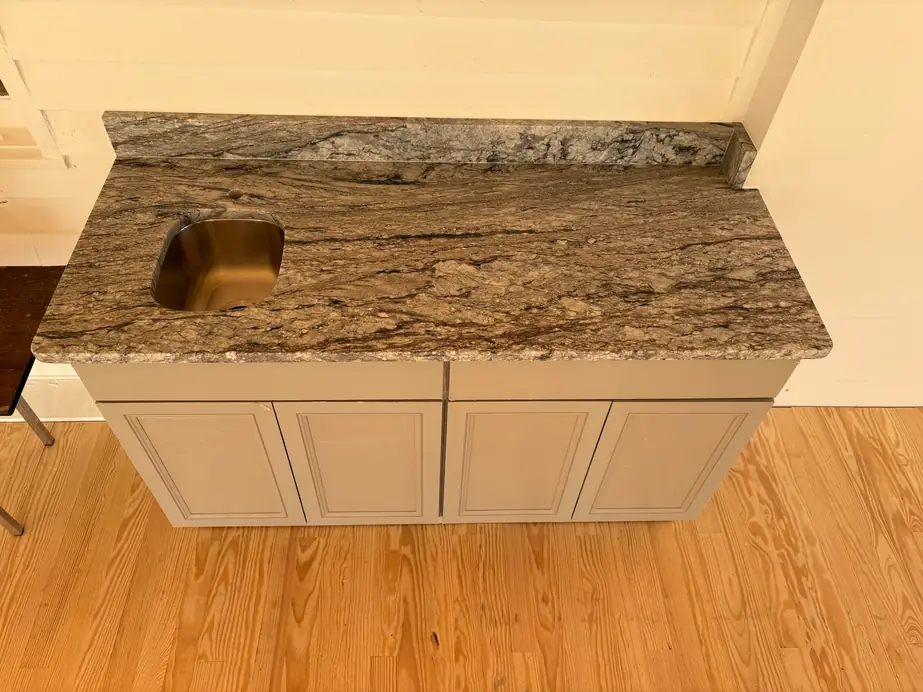
Why most big kitchens have a seam
A slab is only so long, and plenty of kitchens are longer than that. An L-shaped layout, a long wall run or a large island often needs more than one piece of stone. Stone is also heavy and brittle, and a single enormous piece has to get through doorways and around tight corners without cracking. So a seam isn't a flaw. It's a normal part of building a countertop that has to fit a real room.
The craft is in where the seam goes and how well the two pieces are matched, because those two choices decide whether you notice the joint at all.
Where a seam should go
A fabricator looks for a spot where the joint sits over solid cabinet support and stays short and easy to keep flat. They also steer it away from sink and cooktop cutouts, since the narrow strips of stone beside a cutout are weak points, and a joint right there asks for trouble.
On an L-shaped layout there are usually two sensible options. One is a seam at the inside corner, where one leg butts into the other. The other is a seam out along one leg, so the corner is cut into a single piece. Cutting a corner out of one piece of stone can leave the inside corner as a stress point, so many fabricators prefer to put the joint where it relieves that pressure. The right call depends on the cabinets, the sink and the pattern in the slab.
Matching the veining across the joint
Natural stone has a pattern, and the pattern doesn't stop at a seam unless the pieces were cut carelessly. To make the lines carry across, the fabricator lays out both pieces on the same slab, side by side where the stone's pattern is continuous. When the pieces are cut from neighbouring areas of one slab, a vein that leaves one piece at a given angle meets its partner on the other side.
That takes planning before the saw moves. The direction of the pattern is chosen first, the pieces are marked so they keep their order and orientation, and they're cut in sequence. If a layout calls for more stone than one slab can give, pieces from sequential slabs of the same lot have the best chance of agreeing with each other.
- Pieces are cut from the same slab, or from slabs that came out of the same lot in order.
- The direction of the pattern is decided before any cut is made.
- The seam lands where the veining is quiet, rather than where one strong vein crosses at an angle.
- Pieces stay in order and in the same orientation from the saw to the install.
What the installer does at the joint
At install the pieces are dry-fitted first, to confirm the edges meet cleanly and the tops sit at the same height. The seam is then filled with an adhesive tinted to match the stone, and the pieces are drawn tight together with suction-cup seam tools and brought level so you can't feel a ridge with your fingertip. Excess adhesive is scraped away and the joint is cleaned up.
How visible the result is depends on the stone. A busy, speckled granite can hide a joint almost completely. A solid-colour quartz or a pale marble with one bold vein is less forgiving. No seam is truly invisible if you put your eye right down to it, but a well-made one reads as a thin, quiet line rather than a break in the pattern.
A customer's account
A 2025 Google review of Raccoon Stone & Tile Works describes this process from the customer's side. The reviewer had a kitchen with a multi-angled layout, and wrote that the person who cut the stone took real pride in matching the natural patterns where pieces were needed, and that the installer left the joints barely noticeable.
That kind of result comes from a shop that does the templating, cutting and installation itself, so the people planning the seam are also the ones who cut and set it. Raccoon Stone & Tile Works has been a family stone shop since 1998, and the Byron yard lets you look at the full slab your pieces would come from.
If you have an L-shaped or multi-angle kitchen and want to see how the pattern might run, come by 2347 GA-247 Connector in Byron or call (478) 956-2222 to set up a visit.
Raccoon Stone & Tile Works, (478) 956-2222
Call (478) 956-2222More articles
Why You Should Pick the Full Slab, Not a Sample Square
A small sample tells you the name of the stone; the full slab tells you what your countertop will actually look like.
Granite, Quartz, Quartzite or Marble: Choosing a Kitchen Countertop
Each material asks something different of you, and the right one depends on how your kitchen actually gets used.