Why You Should Pick the Full Slab, Not a Sample Square
A small sample tells you the name of the stone; the full slab tells you what your countertop will actually look like.
October 20, 2026 · 4 min read
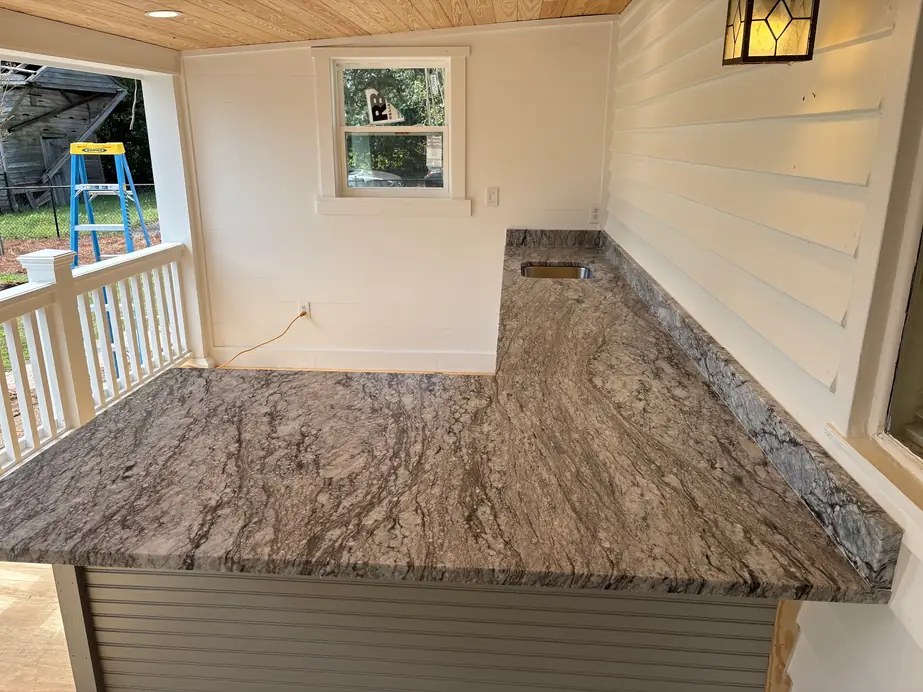
A sample square shows you a sliver
A sample is a small piece cut from one spot on one slab. It tells you the name of the stone and roughly which colour family it belongs to, and that's about all it can promise. Natural stone comes out of the ground, and the ground doesn't repeat itself neatly from one end of a block to the other. The slab your countertop gets cut from can look noticeably different from the square you held up against your cabinets.
Granite and quartzite can carry clouds, streaks and pockets of mineral that gather in one part of a slab and thin out in another. Marble veining tends to run in bands that wander across the surface. Even engineered quartz, which is made to be more consistent, can differ in pattern from one slab to the next. The only way to know what you're buying is to look at the actual piece.
What changes across a single slab
A slab is a big sheet of stone, often close to ten feet on the long side. Over that distance the tone can shift from warmer to cooler, the veining can bunch up near one edge, and a dark band can cut across the middle. None of that is a defect. It's the character that makes natural stone worth choosing, and it's also why two slabs sold under the same name can look more like cousins than twins.
Where your countertop sits on the slab matters, too. A kitchen with a long run and an island will draw pieces from different parts of the stone, and you'll want to see how those areas relate to each other. Seeing the whole slab lets you decide which part lands on the island, where the eye goes first, and which part ends up tucked along a wall.
How to walk a slab yard
Pick a day when you can take your time, and bring a few things that live in your house: a cabinet door or finish sample, a floor tile, a paint chip, and phone photos of the room. Look at the slab standing up, then step back, because stone reads very differently from three feet away than from ten. Here's a short checklist to carry with you.
- Look at both ends of the slab, not only the middle, and check that the colour and pattern you like continue along the whole length.
- Wipe a small area with a damp cloth to see the colour the way it will look once the surface is polished or sealed.
- Look for natural fissures, pits and resin-filled spots, and ask where they sit in relation to your sink and cooktop cutouts.
- Notice whether the pattern runs in one direction, because that decides how pieces and seams will line up.
- Hold your cabinet sample next to the slab in daylight as well as indoors, since light changes how stone reads.
Matching the slab to your layout
Once you've settled on a slab, think about the layout. A good choice accounts for where the sink goes, where a seam might land, and whether a bold vein should travel across the island or wrap down a waterfall edge. That's a conversation worth having with the person who will cut the stone, because they can see how the pieces will fit onto the slab and what will be left over.
It also helps to ask about the slab you're standing in front of rather than the stone in general. Is this the piece that will be cut for your job, or one like it? If you love one particular slab, say so before anything is marked, and have it set aside for you.
What the Raccoon yard offers
Raccoon Stone & Tile Works keeps full slabs in a yard on site in Byron, so you can walk out and choose the actual slab your top will be cut from. One Google reviewer described the difference this way: other places in the area show little one-foot blocks to look at, and some send you to Atlanta to see slabs. Another reviewer wrote that the team found the piece of stone they wanted and made sure they were happy with it before cutting.
If you're still working out material and pattern, Connie is named in two 2025 reviews, one of them thanking her for help choosing material and pattern. The shop Rick and Mary Coon founded in 1998 can hold material for you until your project is ready, so choosing early doesn't mean rushing everything else.
You're welcome to stop by the yard at 2347 GA-247 Connector in Byron, Monday through Friday between 8 and 5, or call (478) 956-2222 first and let us know what you're looking for.
Raccoon Stone & Tile Works, (478) 956-2222
Call (478) 956-2222More articles
Granite, Quartz, Quartzite or Marble: Choosing a Kitchen Countertop
Each material asks something different of you, and the right one depends on how your kitchen actually gets used.
What Happens at a Countertop Templating Visit
The template is where your countertop is really designed, which is why a careful visit takes its time.